Clever Games Sudoku is a free online number puzzle that you solve with logic: every row, column and box must hold the digits 1 to 9 once. Play sudoku online from easy to evil, take on the daily puzzle, or use a hint that explains the next step, with no time limit and no sign-up.
How to play sudoku online?
Pick an empty cell and enter the one digit that fits its row, column and box. That is how to do sudoku, and it works the same way with a mouse, a touch screen or the keyboard.
- Start with Easy. A new player opens the Easy level of Classic, a full 9×9 board. Mini is a smaller 6×6 board with digits 1 to 6. Changing the level starts a new puzzle at once. Restart returns the current puzzle to its starting clues. If you’ve already made a move, confirm before starting over.
- Check the three groups. Look along the selected cell’s row, down its column and inside its outlined 3×3 box. A digit that already appears in any of them cannot go in that cell.
- Enter a digit. Tap the cell, then tap a digit on the number pad. The starting digits are fixed. Tapping one only selects it and highlights every matching digit.
- Use notes for possibilities. Switch on Notes and the pad writes small candidate digits instead of answers. Auto candidates, a switch in the Options menu beside the level select that is off by default, fills them in for you.
- Undo, hint, finish. Undo and Redo have no limit. If you are stuck, press Hint and read the explanation. The puzzle is solved when every cell is filled and no digit repeats.
New to sudoku? Replay the first-move tutorial on the board above. It shows you one cell, one digit and where the Hint button is.
Keyboard: the arrow keys move between cells, 1 to 9 enter a digit (1 to 6 in Mini), Backspace or Delete clears a cell, N switches Notes, H asks for a hint, Ctrl+Z undoes and Ctrl+Y redoes.
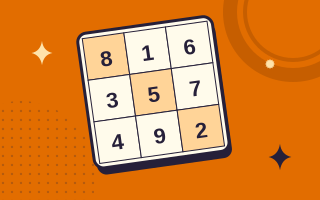
The illustration shows a row with one empty cell. The missing digit is 9, but in a real puzzle you would also check that the column and the box agree. If they do not, an earlier entry needs another look.
What are the sudoku rules?
Classic sudoku uses a 9×9 grid divided into nine 3×3 boxes. Every row, every column and every box must contain each digit from 1 to 9 exactly once. The digits are only symbols: you never add or compare them.
Each puzzle has exactly one correct solution, and the generator checks that before showing it to you. That is why a solution never needs a guess: some cell always has a reason.
An empty cell may allow several candidates at first. A candidate is a digit not yet ruled out, not a promise that it belongs in the final grid. A digit that breaks no rule today can still lead to a dead end later.
Mini follows the same rules on a 6×6 grid. Its digits are 1 to 6 and its boxes are two rows high and three columns wide. Classic adds no extra condition on the long diagonals.
There is no losing here. You finish when the grid is full and has no conflicts, and nothing ends the puzzle early.
Which sudoku difficulty or mode should I choose?
Choose Easy if you are new, then move up when you can explain why each entry is forced. The five Classic levels are named for the hardest technique the puzzle needs, not for how many digits are given at the start.
| Level or mode | What it needs | Good for |
|---|---|---|
| Easy | Naked singles only: a cell with one candidate left | Learning to scan rows, columns and boxes |
| Medium | Adds hidden singles: a digit with one possible cell in a group | Looking for places for a digit, not only digits for a cell |
| Hard | Adds pairs and triples | Tracking candidates with notes |
| Expert | Adds X-wing | Comparing candidates across rows and columns |
| Evil | At least one chain | Following a long implication without guessing |
| Mini | A 6×6 board with digits 1 to 6, one level | A short first puzzle |
| Daily | One Medium puzzle per date, the same for everyone | A shared puzzle to come back to |
Start with an easy sudoku as you learn to scan the grid. If you want a much tougher puzzle, choose Evil, the hardest level here.
The sudoku daily challenge is the same Medium puzzle for every player on a given date, and the day changes at 00:00 UTC. Use it as your sudoku today: one puzzle, no countdown, and a solved message once you finish. If you come back after solving it, the page shows your time and offers a practice puzzle until the next date arrives.
Your pace is timed upward and pausing hides the board. When you finish, the result shows your time, how many hints you used and one of three labels: Expert pace, Steady pace or Keep practicing. It also compares you with your last result at that level.
Which sudoku strategies help when I get stuck?
Work from the most constrained cells and keep each deduction small enough to say out loud. A good sudoku strategy is a ladder: use the simplest technique that works, and climb only when it stops.
- Naked single. Cross off the digits already in a cell’s row, column and box. If one candidate remains, place it.
- Hidden single. Pick a digit missing from a row, column or box and check every cell it could go in. If only one cell can hold it, that digit goes there, even if the cell has other candidates.
- Pairs and triples. If two cells in a group share the same two candidates, those digits belong to those cells, so remove them from the rest of the group. Three cells sharing three candidates work the same way.
- X-wing. If a digit has exactly two possible cells in each of two rows, and they sit in the same two columns, the digit can be removed from the other cells of those columns. Swap rows and columns and it holds too.
- Chains. A chain follows a candidate forward: if this cell is a 4, that cell cannot be a 7, so another cell must be. Read it one link at a time.
Most sudoku tips come down to bookkeeping. Update your notes after every placement, and alternate between scanning cells and scanning digits. A full set of candidates is a starting point for reasoning, not a solution.
How does Explain next step teach sudoku?
Hint finds the simplest next step, names the technique and highlights the cells involved. Press Hint once to see the explanation, for example “Naked pair in row 4”, and press it again to apply the step. The digit then appears on the board.
Reading the explanation before the second press is the learning part. The highlighted cells show the evidence, and the target cell pulses where the conclusion lands. This is also how to solve sudoku, advanced techniques included: you meet X-wings and chains with your own puzzle in front of you, not in a diagram from a book.
There is no limit on hints. The number you used is shown on the result screen, so a hinted finish is never presented as an unaided one.
If a wrong digit is on the board, the hint points at it first, with a message such as “This 7 does not fit. Check row 2”. The solver cannot explain a next step from a board with a mistake in it. Conflict highlighting also marks a repeated digit in red and tells you in words, for example “Row 3 already has a 5”. You can turn it off with the Highlight conflicts switch in Options.
Who might find these sudoku puzzles especially useful?
Beginners can start with Easy or Mini, keep conflict highlighting on and use the first-move tutorial. Returning solvers can pick Medium or Hard and compare their reasoning with the hint. Experienced solvers can go to Expert and Evil for patterns that span several groups.
Students can use a printed sheet to practice one technique at a time, and teachers can use the same sheet in a classroom to talk through why a candidate is impossible. Seniors who prefer paper can print large puzzles and play away from the screen. Families can share a puzzle link and solve the same board side by side. Commuters can use Mini or Easy for a short round, since a puzzle in progress is saved on the device and reopens where you left it.
What are the benefits of practicing sudoku?
Sudoku gives you a structured way to practice elimination, careful checking and patience. It rewards attention to one constraint at a time, and it teaches you to trust a conclusion only when you can show why. The Explain next step hint makes that reasoning visible.
Is sudoku good for your brain? Enjoying a puzzle is a good enough reason to play, but this page makes no medical claims. The National Institute on Aging says the evidence for lasting cognitive benefits from mentally stimulating activities is still incomplete. Treat sudoku as a pleasant part of your day, not as health care.
Where did sudoku come from?
The modern puzzle first appeared in 1979 in a US puzzle magazine under the name Number Place. It is credited to Howard Garns, a retired architect. Its logic grid has older roots in the Latin squares that the mathematician Leonhard Euler studied in the 18th century.
The puzzle became widely popular after a Japanese publisher, Nikoli, began printing it in 1984 under a name that means roughly “the digits must stay single”. From there it spread worldwide, and today people play it on paper and on screens.
How many sudoku puzzles are there? Counting every valid filled grid gives 6,670,903,752,021,072,936,960. Once you treat grids that are rotations, reflections or relabelings of each other as the same, about 5.5 billion remain. Every puzzle here is generated by this site, so you will not run out.
What are the most frequently asked questions about sudoku?
How do you play sudoku without guessing?
Enter a digit only when you can justify it from the current constraints. If a cell allows several choices, leave notes and inspect another group; a placement elsewhere may remove the doubt. Hint can show a deduction you have missed.
How does sudoku work if several digits fit a cell?
A digit that fits locally can still be wrong for the whole grid. The puzzle has one complete solution, and you find it through connected restrictions. A candidate list is not a list of several answers.
Can I print free sudoku puzzles with answers?
Yes. Open Options to choose a number of puzzles from 1 to 6 and whether to include answers, then press Print: your browser’s print dialog opens with US Letter pages. Answers go on a separate page after the puzzles, with no watermark. Printing starts from the original clues and leaves your on-screen entries unchanged.
What is the difference between easy and hard sudoku?
An easy puzzle can be solved with naked singles alone. Harder levels need hidden singles, then pairs and triples, X-wing and finally chains. A hard puzzle does not have fewer given digits; it needs a more advanced technique.
Can I play a free sudoku game online with a keyboard?
Yes. Select a cell, move with the arrow keys and type 1 to 9, or 1 to 6 in Mini. Press N for Notes and H for a hint. The number pad gives touch and mouse players the same actions. This sudoku game online is free to play, and you can find more free sudoku games in the puzzle catalog.
Is sudoku free here, and is there a daily puzzle?
Yes. Sudoku free of charge is the whole point: this is free online sudoku with no sign-up. You can play sudoku online free on a phone or a computer. That online sudoku free of charge covers Classic, Mini and the daily puzzle, and sudoku free online here also works offline once the page has loaded. Looking for sudoku online free daily? That is the Daily mode.
Does sudoku count mistakes?
No. There is no mistake counter and no way to lose. The timer counts up and is not a deadline. Conflict highlighting marks repeated digits and can be switched off, but a finished grid must still be correct.
What are killer sudoku and samurai sudoku?
They are different variants. Killer sudoku adds cages with target sums, and samurai sudoku links overlapping grids. This page offers Classic, Mini and the daily puzzle, so neither is a play mode here. Classic is the standard row, column and box challenge.
How do diagonal sudoku and jigsaw sudoku differ?
Diagonal sudoku adds a no-repeat rule on the two main diagonals. Jigsaw sudoku replaces the square boxes with irregular regions. Neither is a mode on this page; in Classic, follow the outlined 3×3 boxes only.
Is my progress saved, and can I share a puzzle?
Yes. A puzzle in progress is saved on this device and reopens where you left it, with no account. Share opens your device’s share sheet, or copies the link and shows “Link copied” on the button. The link opens the same puzzle from its starting clues; after a win a short line with your time is added. Your notes and filled cells are not sent.